







 Blogs
Blogs When I first began teaching, I was young. Like, way too young to be in charge of a classroom full of teenagers. I dressed older, kept my personal life private, and whenever a student asked my age, I responded, “I’ll tell you when you graduate.”
Back then, I understood every reference my students made. I listened to the same artists and went to the same concerts. A few years later, I still knew who Lil Yachty was, but I definitely wasn’t buying tickets to his shows.
Now, I hate to admit it, but I’m old(er). Keeping up with what young people think is cool takes actual effort, and I occasionally catch myself asking the dreaded question: “What are you even talking about?”
That applies to education trends, too.
In my Sisyphean quest to keep up with what’s new in EdTech, I came across two articles this week that couldn’t have been more different. One explored the benefits of low-tech schools. The other, shared by my colleague Samantha Lundberg, described an Oklahoma school built almost entirely around AI.
Along with my recent work on balanced technology use, the contrast got me thinking: What exactly is the “right” amount of technology in education, and what is just trendy?
How are teachers supposed to decide when one school is intentionally removing screens while another is building its entire model around them?
I’m not here to convince you that either extreme is right or wrong. Instead, I think there’s a much more useful question: What role should technology play in your classroom?
The best use of technology isn’t necessarily more technology or less. It’s intentional technology; You don’t have to pick a side.
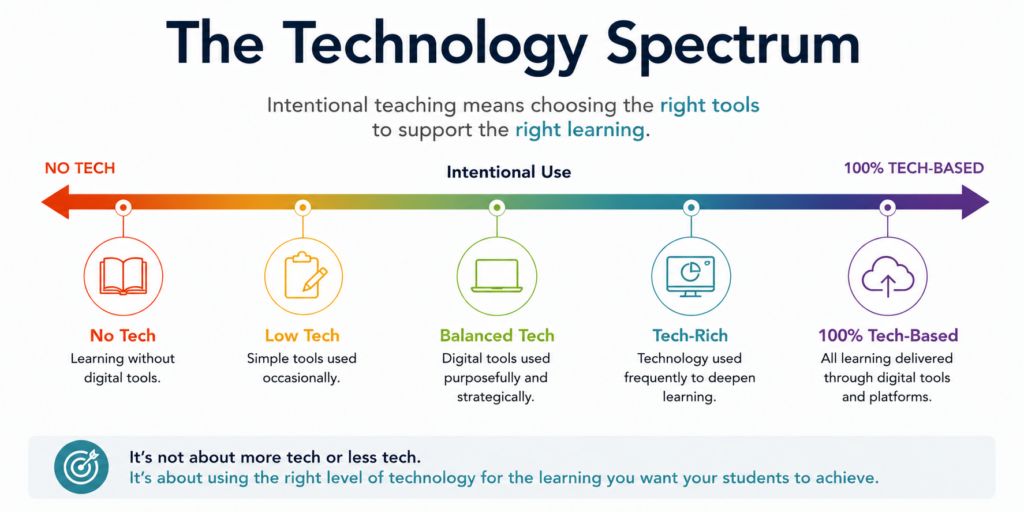
Source: Content developed by the author. Graphic created with AI assistance
To make that decision a little clearer, ask yourself three questions:
What are you trying to accomplish?
Are you teaching students how to add and subtract? Exploring the outcomes of World War I? Helping students distinguish between chemical and physical reactions?
Start with the learning goal, not the tech tool. It can be tempting to discover a shiny new app, platform, or AI tool and then figure out how to squeeze it into a lesson. Flip that process. Decide what students need to learn or experience first, then determine whether technology can help get them there.
What does technology add?
We aren’t here to “tech-shame” anyone. Technology can offer huge benefits! Maybe you’re using Zoom to bring a community elder into your classroom. Maybe you’re showing students a video of an ecosystem completely different from the one outside their window. Maybe a digital tool allows students to collaborate, create, visualize, or access something that otherwise wouldn’t be possible.
If technology meaningfully enhances the learning experience, by all means, go for it.
What does technology remove?
When we talk about technology integration, we often skip this question.
Before adding a piece of technology, ask yourself what students might lose in the process. Does the tool take away an opportunity for students to really grapple with a problem? Does it replace a conversation that could build community? Does it do so much of the thinking that students miss an opportunity to develop a skill themselves? Does it introduce examples or experiences that feel less relevant than something available right in your classroom or community?
Sometimes, the answers to those questions might point you toward skipping the tech, and that’s okay, too.
The goal isn’t to move as far to the right on our tech spectrum as possible. Nor is it to move all the way to the left. The goal is to know why you’re standing where you are.
Trends are worth understanding, but they don’t have to dictate our choices. I don’t need to use whatever is trending in EdTech, but I do want to understand it well enough to know what I’m choosing and what I’m choosing not to use.

Amy Szczepanski (she/her) is a Professional Learning Specialist at Teaching Channel. She holds a B.S. in both Biology and Environmental Science, a Master’s in Teaching, and has been teaching since 2014. Amy uses her experience to create highly engaging and effective content for both teachers and students. She loves all things STEM and is passionate about teacher advocacy.
Fun fact: Amy’s favorite hobby is taking long walks through New York City searching for delicious treats.