








 Blogs
Blogs One of my greatest character flaws is that I’m impatient. I’ve always wanted to be good at things immediately. I wanted to have a great classroom NOW. I wanted to be on the cutting edge of educational trends. More than once (you’d think I would have learned), I found myself trying to overhaul my entire curriculum over the summer to make it “PERFECT” or changing my grading system overnight because I had just taken a training seminar.
Too often, those big changes left me feeling overwhelmed and sometimes with a shakier system than the one I started with. They were the educational equivalent of crash diets: I was looking for quick fixes to problems that didn’t have quick fixes.
In her work on mathematical reasoning, Pam Harris introduces educators to the idea of “shift, turn, and dive in.” A shift is a small change to your teaching practice. A turn requires a little more effort and adjustment. And a dive-in means making a much larger change.
The important part is that there isn’t one right place to start. Where you begin depends on where you are in your own teaching journey—and what you realistically have the capacity to take on. The goal isn’t to make the biggest change possible. It’s simply to start.
If you have the bandwidth to dive in and completely revamp something, great! But don’t underestimate the power of a small shift. Those manageable changes may ultimately be the ones that stick.
So, what might this look like in practice?
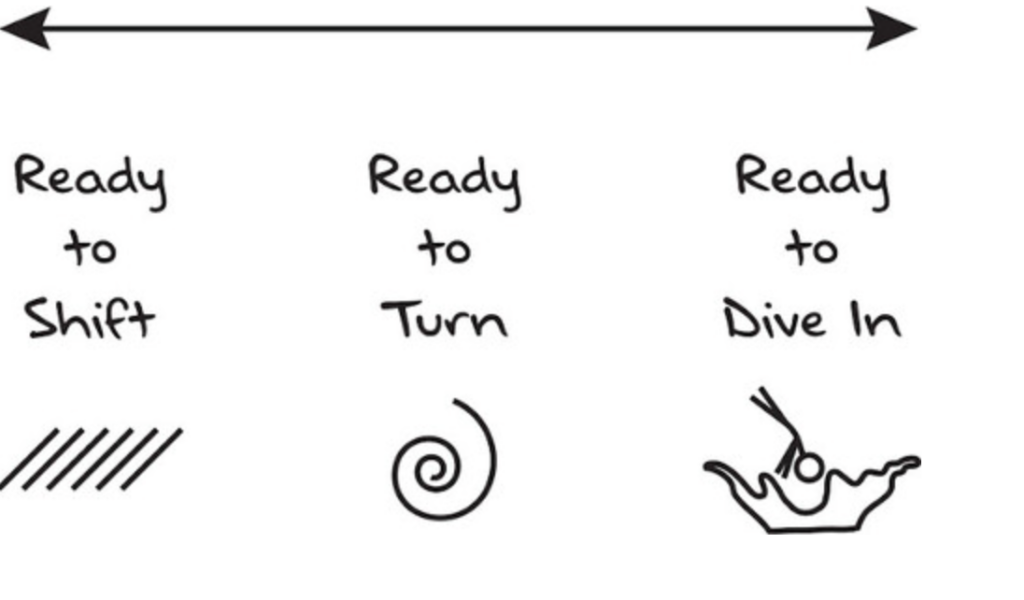
A shift could be as simple as adding one new question to your lesson, giving students another way to complete an assignment, building in five minutes of peer discussion, or changing how you respond when a student gives an incorrect answer.
If you’re ready to go a little deeper, consider making a turn. For example, instead of offering one additional option for an assignment, you might provide several ways for students to access the content or demonstrate their learning.
Ready for an even bigger change? Dive in by redesigning the assignment from the ground up with differentiation in mind.
Each approach can move you toward the same goal. The difference lies in how much you’re changing at one time, and how much change makes sense for you and your classroom right now.
Creating a sustainable teaching practice means being willing to grow and adapt, but it doesn’t mean reinventing the wheel every time a new initiative, strategy, or idea comes along. Meaningful change doesn’t have to happen all at once.
My impatient self still loves the idea of a total overhaul, but experience has taught me that the changes that stick are usually much less dramatic: one adjustment, one experiment, one shift at a time.
Maybe that’s a lesson I could have learned a little sooner.
If mathematical reasoning is an area where you’re ready to make your next shift, you don’t have to overhaul your instruction to get started. Our new Mathematical Reasoning course for K–2 (3–5 coming soon!) explores practical ways to make shifts, turns, and dive-ins that help educators create meaningful, manageable changes that last.

Amy Szczepanski (she/her) is a Professional Learning Specialist at Teaching Channel. She holds a B.S. in both Biology and Environmental Science, a Master’s in Teaching, and has been teaching since 2014. Amy uses her experience to create highly engaging and effective content for both teachers and students. She loves all things STEM and is passionate about teacher advocacy.
Fun fact: Amy’s favorite hobby is taking long walks through New York City searching for delicious treats.